 FundBuddy
Every NDIS plan says how the funding is managed. It might be self-managed, plan-managed, NDIA-managed, or a mix. The choice changes who pays your providers, who keeps the records, and how much control you have day to day. It doesn't change how much funding you have for your supports.
Three ways to manage a plan
Three ways to manage NDIS funding
Self-managed
You (or your nominee) pay providers, claim from the NDIS and keep the records.
Plan-managed
A registered plan manager pays your invoices and keeps the records for you.
NDIA-managed
The NDIA pays providers directly. You must use registered providers.
You can also mix them. For example, self-manage your core supports and plan-manage the rest.
Whichever way your plan is managed, the NDIA says it's still your responsibility to monitor your plan and your spending (Guide to using your funding). A plan manager pays the bills, but knowing what's left is still on you.
Side by side
| Self-managed | Plan-managed | NDIA-managed | |
|---|---|---|---|
| Who pays providers | You | Your plan manager | The NDIA |
| Which providers | Registered or unregistered | Registered or unregistered | Registered only |
| Prices | You can negotiate, above or below the NDIS price limits | Within the NDIS price limits | Within the NDIS price limits |
| Who keeps records | You | Your plan manager | The NDIA |
| Admin for you | Most | Some (approving invoices) | Least |
| Cost | No management fee | A monthly fee, paid from separate plan management funding in your plan (not from your other supports) | No management fee |
Sources: What is self-managed funding, Guide to working with providers.
How a provider gets paid
What plan management costs in 2026–27
The 2026–27 plan management fee
Price limit per month
Same across Australia
Over a full year
12 months at the price limit
The NDIS Pricing Schedule 2026–27 lists plan management as one monthly fee of $104.45 (support item 14_034_0127_8_3). There's no separate set-up fee: the one-off set-up fee was removed from 1 July 2025 (NDIS Pricing Schedule 2026–27, Appendix 7, Table 57). About 65% of participants use a plan manager, according to the NDIA's Annual Pricing Review 2026–27.
So choosing self-management doesn't "free up" that money for other supports. The real difference is who does the admin, and how much control you want.
New rules worth knowing
The Securing the NDIS for Future Generations Act became law on 20 August 2026. Three changes affect how plans are managed:
What's changing, and when
Keep your records. For claims you make, keep the records for 3 years (5 if you're a nominee). The NDIA's self-management guide suggests 5 years, so 5 is a safe habit.
Claim within 90 days. The time to claim for a support drops from 2 years to 90 days after it's delivered.
A panel of plan managers. The NDIA will launch a panel of approved plan managers. If yours isn't on it, the NDIA will support you to move to one that is during a 6-month transition (to April 2028). After that, only plan managers on the panel can provide plan management.
Sources: Department of Health, Disability and Ageing, NDIS: Securing the NDIS, NDIS: Changes to plan management.
For self-managers, the 90-day rule is the big one. A simple fortnightly routine (file the receipts, make the claims) keeps you well inside it.
Could self-managing suit you?
Some people love the control. Others are glad to hand the admin to a plan manager. Neither is wrong. A few honest questions can help:
- Would you like to choose providers, including unregistered ones, and negotiate prices yourself?
- Are you comfortable paying invoices and claiming in the my NDIS app every week or two?
- Do you have a simple way to keep receipts and records for years?
- Would you rather someone else handled invoices, even if it means less day-to-day control?
Self-management isn't available if you're an insolvent under administration; if you've been convicted of an offence involving fraud or dishonesty, or of one punishable by 2 or more years in prison; or if the NDIA thinks self-managing would be an unreasonable risk, or that the funding is unlikely to be spent in line with your plan. The same rules apply to a nominee or child representative. (What is self-managed funding)
A self-manager's checklist
- A separate bank account for NDIS money
- Every invoice and receipt saved, showing the provider's name and ABN, the support dates, the support category, what was provided, the hours or quantity, the price, and the total paid
- Claims made within 90 days (from 1 December 2026)
- Records kept for at least 3 years (5 is safest)
- A running view of what's left in each budget, so the plan lasts the distance
How to change how your plan is managed
You can ask the NDIA to change how your funding is managed at any time, and there's no limit on how often. If that's the only change, it can usually be done as a plan variation, without a full reassessment (NDIS). Talk it through with the NDIA, your LAC or your planner. They can explain what it would mean for your plan.
Where FundBuddy fits
A plan manager provides a service. FundBuddy is a tracking tool. FundBuddy doesn't pay providers, lodge claims, handle invoices or give advice, and it doesn't replace a plan manager. It helps with two lines of that checklist: it keeps your receipts and spending in one place, and shows what's left in each budget.
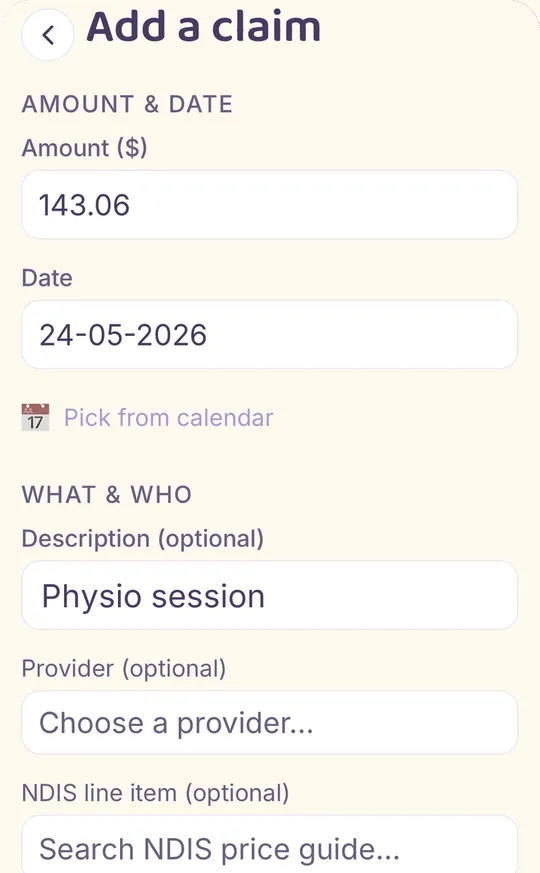
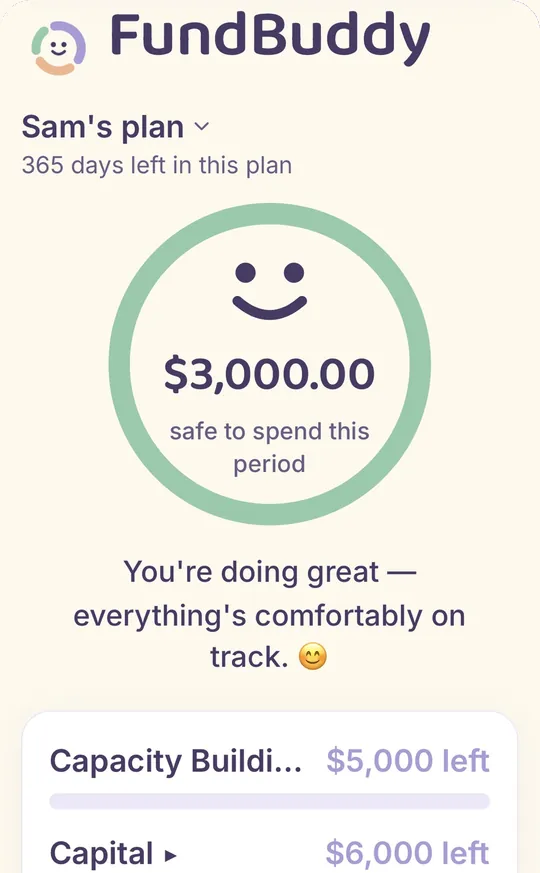
Screens show example figures. Safe-to-spend figures are estimates.
It works the same whether you self-manage, plan-manage or mix, because monitoring your spending is your job either way. With the Family plan (A$14.99/month or A$149.99/year), you can keep up to 4 participants' plans in one account.
Keep track of your NDIS funding, however your plan is managed

Free to download. 7-day free trial, then from A$9.99/month or A$99.99/year, paid by you, not from your NDIS plan. Cancel anytime.
FundBuddy is independent. It is not affiliated with, or endorsed by, the National Disability Insurance Agency (NDIA) or the NDIS. This guide is general information, not financial or legal advice.